More Ice, Less Rise
The Operating Environment and Aircraft Performance
Icing and Aircraft Performance

Figure 1. Structural Icing on an Aircraft
The environmental factor that I would like to talk about for this week's discussion is icing. Although there are many different types of icing on an aircraft, I would just focus on structural icing for this week's discussion as it is the one that directly affects aircraft performance. Structural icing is an environmental factor caused by temperature and precipitation. It is formed only when there are supercooled liquid or snowflakes in clouds and when the air or aircraft temperature is below zero degrees Celsius. When supercooled precipitation in clouds touches a cool aircraft, the cold vapors will instantly sublimate into ice on the aircraft's structure (NASA, 2016). This will cause an ice formation on an aircraft structure, called structural icing.
How does the environmental factor affect aircraft performance
Structural icing has the greatest effect on an aircraft's performance when formed on its wings. When that happens, it changes the cross-section of the wing's airfoil and alters its aerodynamic shape. Maintaining the shape of an airfoil in any aircraft is important as any changes to it can heavily affect an aircraft's drag and angle of attack (AOA) which will affect lift and stall.
As stated in PHAK chapter 5;
- Accumulated ice on a wing's leading edge will cause the air above the wings to separate sooner due to increased leading edge size and non-aerodynamic shape of the airfoil.
- Earlier boundary separation also results in greater turbulence which increases aircraft drag.
- An aircraft will also experience less thrust as the pilot finds himself having to use full power and a high angle of attack just to maintain attitude.
- Earlier separation lowers the critical AOA of the wing which results in a lower lift.
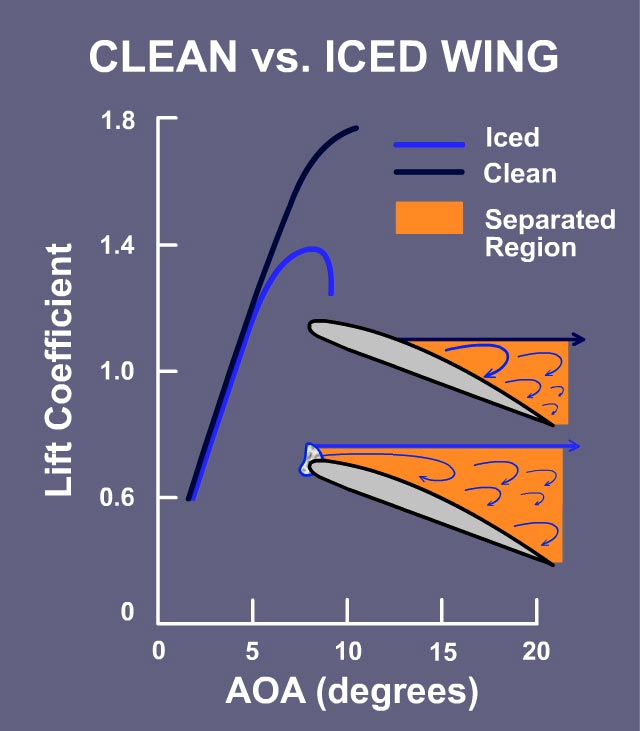
Figure 2. Comparison of Clean vs. Iced Wing, (NASA, 2016)
Minimizing the Impact of Icing
To minimize the impact of icing, there are both de-icing and anti-icing methods available.
AVOIDANCE METHODS
- As much as possible, pilots should avoid flying into areas known for their icing conditions and consult a weather office or flight service station to get a grasp of the day's icing conditions.
DE-ICING
![PDF] Aircraft De-Icing System Using Thermal Conductive Fibers ...](https://d3i71xaburhd42.cloudfront.net/5e398e704ef2cfd5ac95457d3d9b682bdfdfff03/25-Figure8-1.png)
Figure 3. Pneumatic Boots, (Goodrich, n.d.)
- Rubber Boots: Placed at leading edges, membranes of rubber are made to pneumatically expand in such a way that ice is cracked and broken off after it has already formed.
- Fluids: Heated fluids can be sprayed over aircraft that have ice formed on their airframe, clearing the aircraft of any icing before flight.
ANTI-ICING
- Heating Devices: Below are two ways that aircraft can use heat to prevent ice from forming
Engine Bleed Air: Turbine engines bleed hot air from a section of the aircraft engines to areas where structural icing usually forms.
Electrothermal Heating: For piston type and turboprop engines with no bleed air, electrothermal heating elements can be placed at areas where structural icing usually forms.
- Fluids: Special fluids have anti-freezing elements that can prevent ice from forming. During flight, they can be released through slinger rings or porous leading edge members, allowing the fluids to flow over the blades of the propellers and the surfaces of the wings. Before flight, such fluids can also be sprayed and coated on the airframe.
(Word count: 552)
References
Icing Hazards. Weather.gov. Retrieved 21 August 2020, from https://www.weather.gov/source/zhu/ZHU_Training_Page/icing_stuff/icing/icing.htm.
NASA. (2016). In-Flight Icing: Aerodynamics of Icing - Handling Effects. Aircrafticing.grc.nasa.gov. Retrieved 21 August 2020, from https://aircrafticing.grc.nasa.gov/1_1_3_3.html.
Pilot’s Handbook of Aeronautical Knowledge. (2016). [Ebook]. Retrieved 21 August 2020, from https://www.faa.gov/regulations_policies/handbooks_manuals/aviation/phak/media/07_phak_ch5.pdf.

Comments
Post a Comment